How Many Electric Motorcycles Fit in a 40HQ Container? Complete Loading Guide
One of the most frequently asked questions from first-time EV importers is deceptively simple: how many electric motorcycles or tricycles can I fit in a container? The answer depends on the container type, the vehicle ca
Last reviewed on February 23, 2026
Quick Take
One of the most frequently asked questions from first-time EV importers is deceptively simple: how many electric motorcycles or tricycles can I fit in a container? The answer depends on the container type, the vehicle ca
How Many Electric Motorcycles Fit in a 40HQ Container? Complete Loading Guide
One of the most frequently asked questions from first-time EV importers is deceptively simple: how many electric motorcycles or tricycles can I fit in a container? The answer depends on the container type, the vehicle category, the packing method, and how well the loading is optimized.
Getting this right matters because it directly affects your per-unit freight cost. Underestimate the capacity and you leave money on the table by shipping air. Overestimate and you may find your order does not fit, causing last-minute splits and delays. This guide gives you the exact numbers for every major EV product category and explains the packing methods that maximize container utilization.
Container Types: 40HQ vs 20GP
Two container types dominate electric vehicle shipping from China.
40HQ (40-Foot High-Cube Container)
- Internal dimensions: 12.03m (L) x 2.35m (W) x 2.70m (H)
- Usable volume: approximately 76 cubic meters
- Maximum payload: 26,740 kg
- Best for: complete vehicles (motorcycles, tricycles), large parts shipments
The 40HQ is the standard for shipping assembled or semi-assembled electric vehicles. The extra height compared to a standard 40-foot container (2.70m vs 2.39m) provides critical headroom for stacking motorcycles and fitting tricycles.
20GP (20-Foot General Purpose Container)
- Internal dimensions: 5.90m (L) x 2.35m (W) x 2.39m (H)
- Usable volume: approximately 33 cubic meters
- Maximum payload: 21,770 kg
- Best for: batteries, spare parts, accessories, small component shipments
The 20GP is the workhorse for dense, heavy shipments like lithium battery packs and boxed spare parts.
Loading Capacities by Product Category
These figures are based on standard loading configurations used by experienced Chinese EV factories. Actual numbers may vary slightly based on specific model dimensions and packing arrangements.
Two-Wheeler (2W) Electric Vehicles -- 40HQ Container
| Vehicle Type | Units per 40HQ | Typical Dimensions | Notes |
|---|---|---|---|
| Delivery scooter (small frame) | 38-40 | 1.6m x 0.65m x 1.0m | Mirrors removed, handlebars folded |
| Commuter scooter (standard) | 35-38 | 1.8m x 0.70m x 1.05m | Standard packing with foam protection |
| Electric motorcycle (large frame) | 28-32 | 2.0m x 0.75m x 1.1m | Requires more floor space per unit |
The target quantity for group buy batches for 2W vehicles is 36 units, which represents the sweet spot for most electric scooter models in a 40HQ container.
Key factors affecting 2W loading:
- Handlebar width is usually the limiting dimension. Folding or removing handlebars can gain 2-4 extra units.
- Battery location matters. Vehicles with under-seat batteries stack more efficiently than those with frame-mounted battery packs.
- Wheel diameter affects stacking height. 10-inch wheel models stack better than 17-inch wheel motorcycles.
Three-Wheeler (3W) Electric Vehicles -- 40HQ Container
| Vehicle Type | Units per 40HQ | Typical Dimensions | Notes |
|---|---|---|---|
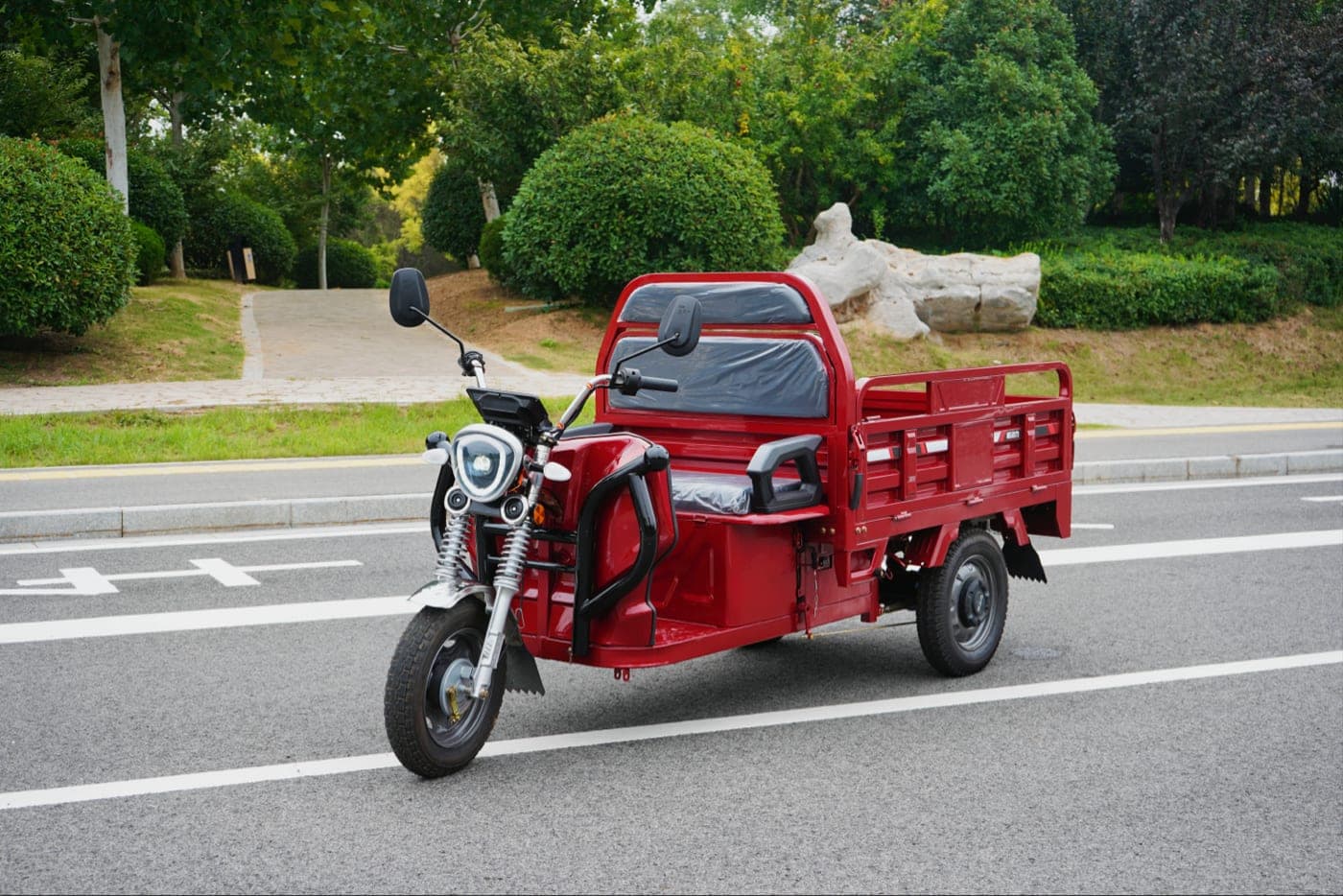
| Cargo tricycle (open bed) | 16-20 | 2.8m x 1.0m x 1.3m | Cargo bed may need partial disassembly |
| Passenger tricycle (enclosed) | 14-16 | 3.0m x 1.2m x 1.7m | Roof panels often shipped separately |
| Heavy cargo tricycle | 12-14 | 3.2m x 1.3m x 1.5m | Largest footprint per unit |
The target quantity for group buy batches for 3W vehicles is 20 units. Cargo tricycles with open beds can achieve this number, while enclosed passenger models typically max out around 16.
Key factors affecting 3W loading:
- Width is the critical dimension. Most 3W vehicles are 950mm-1300mm wide, and the container interior is 2350mm, allowing exactly 1-2 across depending on the model.
- Length determines how many rows you get. At 2800mm per vehicle and 12030mm container length, you get approximately 4 rows.
- Nesting or partial disassembly (removing canopy, folding cargo bed sides) can add 2-4 units.
Batteries -- 20GP Container
| Battery Type | Units per 20GP | Weight per Unit | Notes |
|---|---|---|---|
| 60V 20Ah lithium pack | 90-100 | 8-10 kg | Weight is rarely the limit |
| 72V 40Ah lithium pack | 80-90 | 15-18 kg | Stacked on pallets with UN packaging |
| 60V 45Ah LFP pack | 70-80 | 20-25 kg | Heavier chemistry, fewer units |
Battery shipments in a 20GP container are almost always volume-limited rather than weight-limited. Proper UN-specification packaging (including cushioning, insulation, and ventilation space) reduces effective capacity.
Important: All lithium battery shipments require UN38.3 certification, proper MSDS documentation, and Class 9 dangerous goods labeling. See our certification guide for details.
Spare Parts and Accessories -- 20GP Container
| Part Type | Units per 20GP | Notes |
|---|---|---|
| Controllers | 800-1000 | Small box items, high density |
| Chargers | 500-800 | Medium box items |
| Motors (hub motors) | 300-400 | Heavy, weight can become limiting |
| Tires | 400-600 | Can be compressed for shipping |
| Fenders/body panels | 300-500 | Bulky but light, volume-limited |
Parts shipments are ideal for 20GP containers because the items are smaller and can be palletized efficiently.
Packing Methods: KD, CKD, SKD, and CBU
The packing method you choose has a dramatic impact on how many units fit in a container and, therefore, your per-unit freight cost.
CBU (Completely Built Up)
The vehicle ships fully assembled, exactly as it would be ridden. Only mirrors and possibly handlebars are removed for packing efficiency.
- Pros: No assembly required at destination. Fastest time to market.
- Cons: Lowest container utilization. Highest per-unit freight.
- Best for: Markets with limited assembly capability. Small orders where assembly labor cost would exceed the freight savings.
SKD (Semi Knocked Down)
Major components are attached, but some parts are removed and packed separately. Typical SKD disassembly includes removing wheels, handlebars, seat, mirrors, and battery pack.
- Pros: 15-25% more units per container vs CBU. Moderate assembly effort at destination (1-2 hours per unit).
- Cons: Requires basic tools and mechanical skill. Risk of damage during reassembly if workers are inexperienced.
- Best for: Most importers with basic workshop capability.
CKD (Completely Knocked Down)
The vehicle is disassembled into major subassemblies: frame, motor/wheel, battery, controller, wiring harness, body panels, suspension, and smaller components. Each subassembly is boxed separately.
- Pros: 40-60% more units per container vs CBU. May qualify for lower import tariffs in some countries (classified as parts rather than finished vehicles).
- Cons: Requires skilled assembly labor (4-8 hours per unit). Needs proper tooling and a clean workspace. Higher risk of missing or damaged components.
- Best for: Large-volume importers with established assembly operations. Markets where tariff reduction on parts justifies the assembly cost.
KD (Knocked Down)
Similar to CKD but with even further disassembly. Frame may be unwelded, motor separated from wheel, wiring not pre-assembled.
- Pros: Maximum container density. Lowest freight per unit. May qualify for "local manufacturing" incentives in some countries.
- Cons: Requires factory-level assembly capability. Welding, wiring, and testing equipment needed. Significant quality risk if assembly is not controlled.
- Best for: Licensee manufacturers setting up local assembly plants.
Loading Optimization Tips
Whether you are managing your own shipment or participating in a group buy batch, these tips help maximize container utilization:
-
Use the dead space. Pack smaller items (chargers, spare parts, tools, manuals) in the gaps between vehicles. The space under frames and above wheels is often wasted.
-
Protect strategically. Use foam inserts at contact points rather than wrapping entire vehicles. Full-wrap protection wastes volume. Strategic protection at handlebars, mirrors, and painted surfaces is more efficient.
-
Alternate orientation. For 2W vehicles, alternating the direction of adjacent units (one facing forward, next facing backward) often creates a tighter pack.
-
Remove batteries for separate packing. If the battery pack is removable, removing it from the vehicle and packing batteries in a dedicated section of the container can save significant space and simplify dangerous goods compliance.
-
Stack vertically when possible. Many electric scooters can be secured vertically on their rear wheels, dramatically reducing floor space per unit. This requires proper strapping and bracing.
-
Coordinate with the factory. Experienced Chinese EV manufacturers have loaded hundreds of containers. Ask for their recommended loading plan -- most will provide a loading diagram showing exact unit placement.
How Group Buying Optimizes Container Loading
One of the advantages of container group buying is that the platform handles loading optimization across multiple buyers' orders. When several buyers share a container, the platform coordinates with the factory to:
- Maximize total units in the container
- Ensure each buyer's units are clearly separated and labeled
- Include all documentation for each buyer's portion of the shipment
- Achieve the lowest possible per-unit freight rate
You can see current batch fill levels and target quantities on every product page. The more units in a batch, the lower everyone's freight cost.
Planning your next EV import? Browse available products to see current container loading configurations and batch availability for your destination port.
Related articles
More guides from the same topic cluster.
Shipping & Logistics
Electric Cargo Tricycle Buyer's Guide: Load Capacity, Range & Wholesale Pricing
The electric cargo tricycle is the workhorse of emerging-market logistics. From market vendors and farmers to courier fleets and construction crews, millions of small businesses move goods on three wheels -- and they are
Shipping & Logistics
Four-Wheel Electric Vehicles for Business: Golf Carts & Mini Trucks Import Guide
Two- and three-wheelers dominate the emerging-market EV story, but a fast-growing category sits just above them: the **four-wheel low-speed electric vehicle (LSEV)**. These cover everything from utility golf carts that m
Shipping & Logistics
What Is Container Group Buying? How Shared Shipping Cuts Your EV Import Costs by 33%
If you are a small dealer or distributor importing electric vehicles from China, you have probably felt the sting of container shipping costs. A single 40-foot high-cube container from Ningbo to Lagos costs thousands of