Electric Cargo Tricycles vs Passenger Tricycles: Choosing the Right Model for Your Market
The electric tricycle wholesale market is one of the fastest-growing segments in emerging-market mobility. From last-mile delivery fleets in Lagos to passenger transport networks in Nairobi, electric three-wheelers are r
Last reviewed on February 23, 2026
Quick Take
The electric tricycle wholesale market is one of the fastest-growing segments in emerging-market mobility. From last-mile delivery fleets in Lagos to passenger transport networks in Nairobi, electric three-wheelers are r
Electric Cargo Tricycles vs Passenger Tricycles: Choosing the Right Model for Your Market
The electric tricycle wholesale market is one of the fastest-growing segments in emerging-market mobility. From last-mile delivery fleets in Lagos to passenger transport networks in Nairobi, electric three-wheelers are replacing petrol-powered alternatives at an accelerating pace. But the decision between cargo and passenger configurations is not simply about what you want to sell -- it is about what your market actually needs. This guide gives B2B importers the technical and commercial knowledge to make the right choice.
Understanding the Two Categories
At their core, cargo and passenger electric tricycles share the same basic architecture: a three-wheeled platform with an electric motor, battery pack, and controller. The differences lie in body design, load engineering, and regulatory classification.
Electric Cargo Tricycles
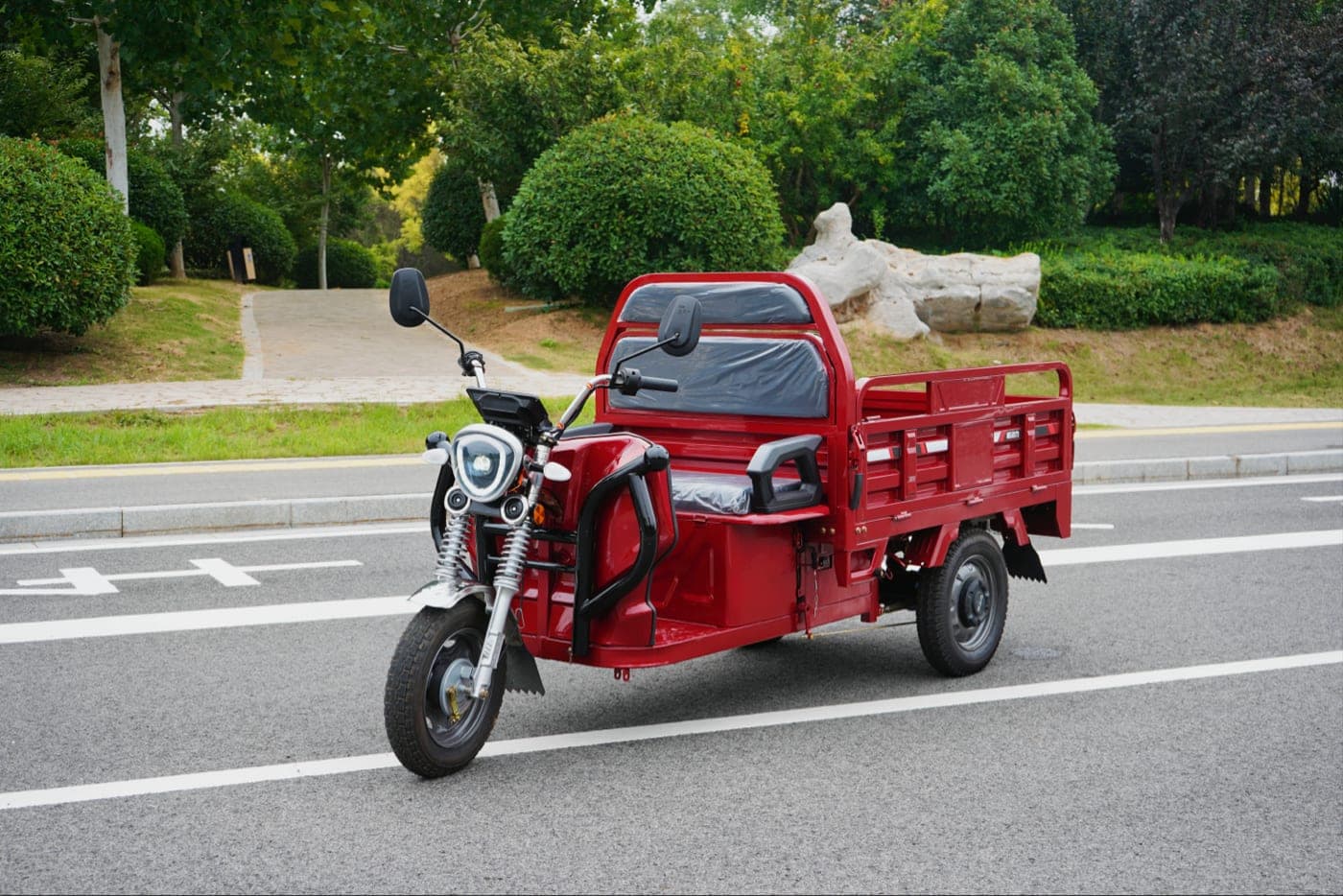
Cargo tricycles are engineered for hauling goods. They feature an open or enclosed cargo bed (typically at the rear, sometimes at the front) mounted on a reinforced chassis. The cargo area is flat-floored, often with fold-down sides for easy loading, and sized to accommodate standard packaging, produce crates, building materials, or bulk goods.
Key specifications:
- Motor Power: 1500W - 2000W (brushless DC hub motor or differential rear axle motor)
- Battery: 60V 45Ah to 72V 60Ah LFP (Lithium Iron Phosphate)
- Load Capacity: 300 - 500 kg payload (excluding driver)
- Range: 50 - 80 km per charge (loaded)
- Top Speed: 30 - 45 km/h
- Cargo Bed Size: 1.2m x 1.0m to 1.8m x 1.2m
- EXW Price Range: $680 - $1,080
Cargo models are the backbone of urban logistics in emerging markets. They replace everything from donkey carts to aging petrol three-wheelers, offering dramatically lower operating costs and zero tailpipe emissions. The total cost of ownership over five years is typically 40-60% less than a comparable petrol-powered cargo tricycle.
Electric Passenger Tricycles
Passenger tricycles -- known as tuk-tuks, keke napep, bajaj, or auto-rickshaws depending on the market -- are designed to carry people. They feature an enclosed or semi-enclosed cabin with bench seating for 4 to 6 passengers, weather protection (roof and side panels), and a dedicated driver compartment.
Key specifications:
- Motor Power: 1500W - 2000W (differential motor preferred for passenger comfort)
- Battery: 60V 52Ah to 72V 72Ah LFP
- Passenger Capacity: 4 - 6 passengers (plus driver)
- Range: 60 - 100 km per charge
- Top Speed: 35 - 50 km/h
- Cabin Type: Fully enclosed, semi-enclosed, or open-sided
- EXW Price Range: $880 - $1,380
Passenger models command a higher price than cargo variants due to the cabin structure, seating, lighting, and safety features (seatbelts, rollover protection in premium models). However, they also generate higher revenue per unit for operators, making the payback period comparable.
Head-to-Head Comparison
| Feature | Cargo Tricycle | Passenger Tricycle |
|---|---|---|
| Primary Use | Goods transport, delivery | People transport, taxi |
| Load/Capacity | 300-500 kg payload | 4-6 passengers |
| Motor Range | 1500W-2000W | 1500W-2000W |
| Battery Size | 60V 45Ah - 72V 60Ah | 60V 52Ah - 72V 72Ah |
| Range (loaded) | 50-80 km | 60-100 km |
| EXW Price | $680-$1,080 | $880-$1,380 |
| Container Loading | 18-20 per 40HQ | 16-18 per 40HQ |
| Revenue Model | Per-delivery or fleet lease | Per-ride fare |
| Maintenance Cost | Lower (simpler body) | Higher (cabin, seats, lights) |
| Regulatory Complexity | Lower | Higher (passenger safety) |
Market Analysis: Where Each Model Thrives
Cargo Tricycles: Best Markets and Use Cases
Africa -- Last-Mile Delivery: In cities like Lagos, Accra, and Dar es Salaam, cargo tricycles are filling the gap between motorcycle couriers (limited payload) and delivery vans (too expensive, stuck in traffic). E-commerce growth across sub-Saharan Africa is driving demand for affordable, reliable delivery vehicles. Read more about Nigeria's specific opportunity.
Latin America -- Construction and Agriculture: In secondary cities across Mexico, Colombia, and Peru, electric cargo tricycles move building materials, agricultural produce, and bottled goods through narrow streets where full-size trucks cannot operate.
South Asia -- Urban Logistics: India, Bangladesh, and Pakistan have enormous fleets of petrol-powered cargo three-wheelers ripe for electric conversion. Government incentives are accelerating the transition.
Passenger Tricycles: Best Markets and Use Cases
Nigeria -- Electric Keke Napep: Nigeria's iconic keke napep (three-wheeled passenger taxi) market is the single largest opportunity for passenger electric tricycles in Africa. Lagos alone has an estimated 50,000 keke napep operating daily. Transitioning even a fraction of this fleet to electric would represent thousands of units. Learn more about importing to Nigeria.
East Africa -- Urban Transport: In Mombasa, Kampala, and Addis Ababa, passenger tricycles supplement minibus networks, particularly for short-distance routes and areas underserved by formal transit.
Southeast Asia -- Tourist and Urban Taxi: Markets like the Philippines, Cambodia, and Myanmar have established tuk-tuk cultures ready for electric upgrades, driven by both government mandates and fuel cost savings.
Container Loading and Logistics
Three-wheelers are larger than two-wheelers and require careful container planning:
- 40HQ Container -- Cargo Models: 18-20 units (SKD, semi knocked down)
- 40HQ Container -- Passenger Models: 16-18 units (SKD)
- CBU (Fully Built): Reduces capacity by approximately 30% but eliminates assembly needs
SKD shipping is standard for tricycles. Units arrive with the main body, motor, and drivetrain pre-assembled. Local assembly involves mounting the cargo bed or passenger cabin, connecting wiring, and installing wheels and accessories. A two-person team can assemble one SKD tricycle in 2-4 hours.
Through EV GroupBuy's container sharing model, importers who need fewer than a full container can join a shared batch headed to their port. This brings per-unit freight costs down to levels that were previously only available to bulk importers ordering 100+ units.
Making the Decision: A Framework for Importers
Ask yourself these five questions before choosing between cargo and passenger models:
1. What does your market already use? If petrol keke napep or tuk-tuks are everywhere, passenger models have an established customer base. If motorcycle couriers dominate delivery, cargo tricycles open a new segment.
2. What are the regulations? Passenger vehicles face stricter safety and licensing requirements in most markets. Cargo tricycles are often classified as utility vehicles with simpler registration processes.
3. What is the financing landscape? Passenger tricycles generate daily revenue, making them attractive for asset financing and pay-as-you-go models. Cargo tricycles may require fleet contracts with logistics companies.
4. Can you support after-sales? Both categories need spare parts and service capability. Passenger models have more components (cabin, seats, lighting) that may need replacement.
5. What is your budget? A container of cargo tricycles (18-20 units at $680-$1,080 each) requires $12,000-$21,600 in product cost. A container of passenger models (16-18 units at $880-$1,380 each) requires $14,000-$24,800.
Why Not Both?
Many successful importers start with one category, establish their service and parts network, and then expand to the other. The motor, battery, and controller components are often interchangeable between cargo and passenger models from the same manufacturer, simplifying your spare parts inventory.
Browse our catalog to compare available cargo and passenger tricycle models with full specifications and transparent pricing. Or learn how group buying works to import your first container at the lowest possible per-unit cost. The electric tricycle revolution in emerging markets is not coming -- it is already here.
Related articles
More guides from the same topic cluster.
Shipping & Logistics
Electric Cargo Tricycle Buyer's Guide: Load Capacity, Range & Wholesale Pricing
The electric cargo tricycle is the workhorse of emerging-market logistics. From market vendors and farmers to courier fleets and construction crews, millions of small businesses move goods on three wheels -- and they are
Shipping & Logistics
Four-Wheel Electric Vehicles for Business: Golf Carts & Mini Trucks Import Guide
Two- and three-wheelers dominate the emerging-market EV story, but a fast-growing category sits just above them: the **four-wheel low-speed electric vehicle (LSEV)**. These cover everything from utility golf carts that m
Shipping & Logistics
What Is Container Group Buying? How Shared Shipping Cuts Your EV Import Costs by 33%
If you are a small dealer or distributor importing electric vehicles from China, you have probably felt the sting of container shipping costs. A single 40-foot high-cube container from Ningbo to Lagos costs thousands of