Understanding EV Freight Costs: Why Per-Unit Shipping Drops When You Group Buy
Freight is one of the largest variable costs in importing electric vehicles from China. Unlike the FOB product price, which is relatively fixed for a given model and order quantity, your per-unit freight cost can vary dr
Last reviewed on February 23, 2026
Quick Take
Freight is one of the largest variable costs in importing electric vehicles from China. Unlike the FOB product price, which is relatively fixed for a given model and order quantity, your per-unit freight cost can vary dr
Understanding EV Freight Costs: Why Per-Unit Shipping Drops When You Group Buy
Freight is one of the largest variable costs in importing electric vehicles from China. Unlike the FOB product price, which is relatively fixed for a given model and order quantity, your per-unit freight cost can vary dramatically depending on one factor: how full the shipping container is.
This article breaks down the freight cost structure for EV imports, shows you base rates for major shipping routes, explains the 5-tier pricing system that determines what you actually pay, and demonstrates why importing alone almost always costs significantly more than group buying.
The Freight Cost Structure for EV Imports
When you ship a container of electric vehicles from China to an international destination, the total freight cost is composed of several elements:
-
Ocean freight: The cost charged by the shipping line for transporting the container from the origin port (typically Ningbo, Shanghai, or Shenzhen) to the destination port. This is the largest component.
-
Origin charges: Port handling, container loading, documentation, and export customs clearance at the Chinese port. Typically $150-$300 per container.
-
Destination charges: Port handling, terminal handling charges (THC), and unloading at the destination port. Varies by port but typically $200-$500 per container.
-
Insurance: Marine cargo insurance covering the transit. Usually 0.3-0.8% of the cargo value.
-
Surcharges: These fluctuate and may include fuel (BAF/bunker adjustment factor), currency adjustment (CAF), peak season surcharges, and port congestion surcharges.
The critical insight is that items 1-5 are priced per container, not per unit. Whether there are 5 electric motorcycles or 36 in the container, the shipping line charges the same amount. This is why container utilization is the single biggest lever on your per-unit freight cost.
Base Freight Rates by Route
The following table shows approximate base freight rates per unit for key shipping routes, assuming a full container (100% fill). These rates are for 2W (electric motorcycle/scooter) shipments in a 40HQ container with a target of 36 units.
| Route | Destination Port | Base Freight/Unit (2W) | Transit Days |
|---|---|---|---|
| China to West Africa | Lagos, Nigeria | $120 | 35-42 |
| China to West Africa | Tema, Ghana | $115 | 33-40 |
| China to East Africa | Mombasa, Kenya | $110 | 25-32 |
| China to Latin America | Veracruz, Mexico | $85 | 25-30 |
| China to Latin America | Buenaventura, Colombia | $95 | 28-35 |
| China to Latin America | Callao, Peru | $90 | 30-35 |
| China to South Asia | Chittagong, Bangladesh | $75 | 18-22 |
| China to South Asia | Colombo, Sri Lanka | $70 | 15-20 |
| China to Middle East | Jebel Ali, UAE | $80 | 18-24 |
| China to Middle East | Jeddah, Saudi Arabia | $85 | 20-26 |
Note: These are base rates at full container utilization. The actual rate you pay depends on the container fill level, as explained in the tier system below.
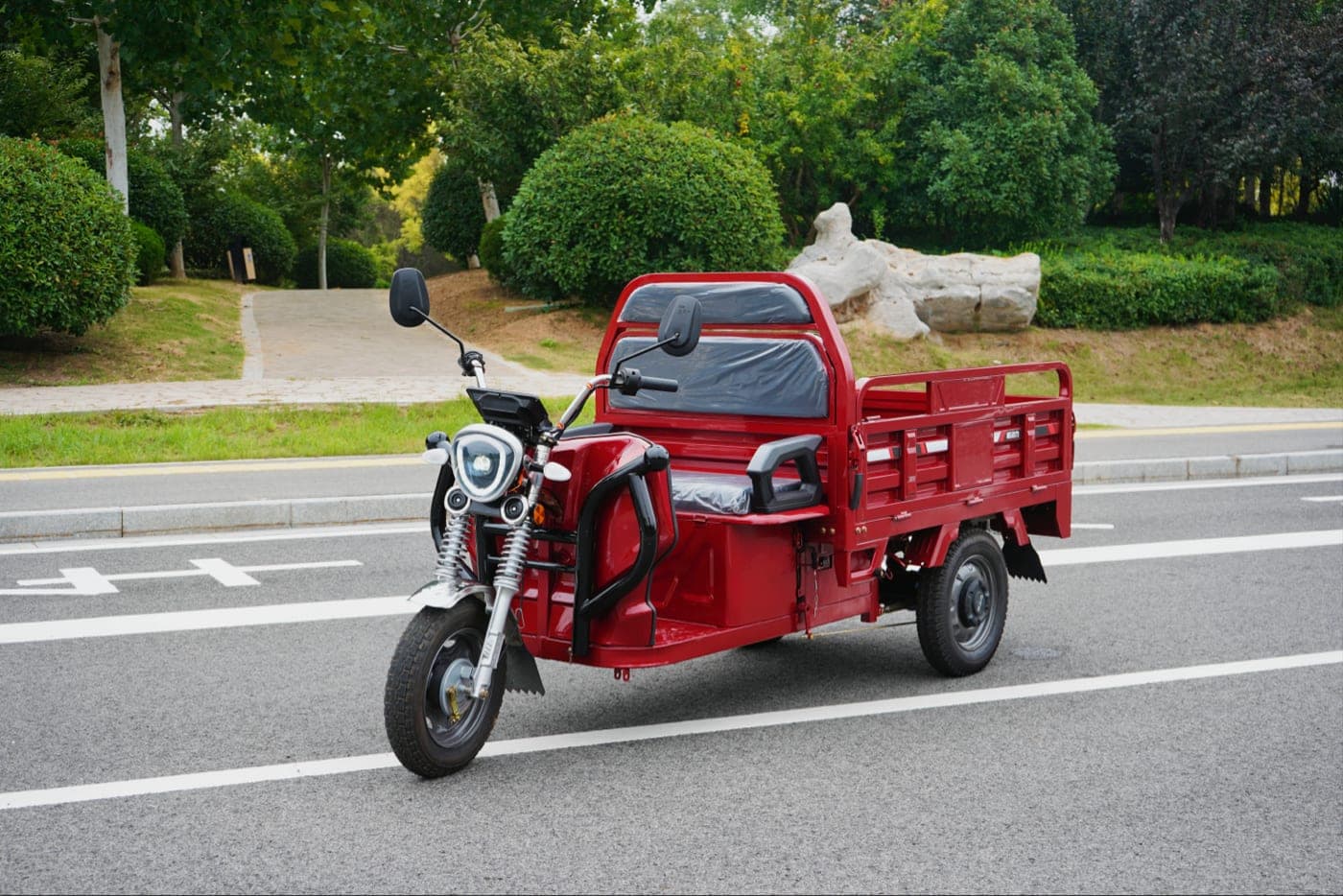
For 3W (electric tricycle) shipments, base freight per unit is approximately 2x the 2W rate due to the larger space each unit occupies (target 20 units per 40HQ vs 36 for 2W).
The 5-Tier Freight Pricing System
The EV GroupBuy platform uses a transparent 5-tier pricing system that calculates your per-unit freight based on the current container fill percentage. As more buyers join a batch and the container fills up, the per-unit freight decreases for everyone in the batch.
| Tier | Container Fill | Freight Multiplier | Description |
|---|---|---|---|
| Tier 1 | 0-24% filled | 1.50x base rate | Near-empty container. Maximum per-unit cost. |
| Tier 2 | 25-49% filled | 1.35x base rate | Quarter to half full. Freight is improving. |
| Tier 3 | 50-74% filled | 1.20x base rate | Half to three-quarters. Significant savings. |
| Tier 4 | 75-99% filled | 1.10x base rate | Nearly full. Excellent freight rate. |
| Tier 5 | 100% filled | 1.00x base rate | Full container. Optimal per-unit freight. |
This tier system reflects a simple economic reality: the total container cost is fixed, and adding more units divides that fixed cost across more buyers.
Real Calculation Example: Lagos Route
Let us work through a complete example for an importer shipping electric motorcycles to Lagos, Nigeria.
Given:
- Base freight per unit (at full container): $120
- Target container fill: 36 units (2W in 40HQ)
- Total container cost (ocean freight + origin + destination + insurance): approximately $4,320
Scenario A: Solo Shipment (8 units)
You ship 8 units in a container. Container fill: 8/36 = 22% (Tier 1).
- Freight multiplier: 1.50x
- Per-unit freight: $120 x 1.50 = $180
- Your total freight cost: 8 x $180 = $1,440
But wait -- the container still costs approximately $4,320. You are paying $1,440 while the remaining $2,880 of container capacity is wasted. In reality, if you were truly shipping solo, you would pay the full container cost divided by your units: $4,320 / 8 = $540 per unit. The tier system assumes other buyers will eventually join the batch.
Scenario B: Group Buy (24 units across 4 buyers)
The batch has 24 units from 4 different buyers. Container fill: 24/36 = 67% (Tier 3).
- Freight multiplier: 1.20x
- Per-unit freight: $120 x 1.20 = $144
- Your freight for 8 units: 8 x $144 = $1,152
- Savings vs solo: $288 (20% reduction)
Scenario C: Full Container Group Buy (36 units across 6 buyers)
The batch fills completely with 36 units from 6 buyers. Container fill: 100% (Tier 5).
- Freight multiplier: 1.00x
- Per-unit freight: $120 x 1.00 = $120
- Your freight for 8 units: 8 x $120 = $960
- Savings vs solo: $480 (33% reduction)
The difference between Scenario A and Scenario C is $60 per unit. On an electric motorcycle that costs $1,200 FOB, that $60 represents a 5% reduction in your total landed cost -- purely from logistics optimization.
Why Solo Shipping Costs 50% More
The math is unforgiving for solo shippers. Here is why:
Fixed costs do not shrink with fewer units. The shipping line charges the same for the container whether it holds 10 units or 36. Origin and destination handling charges are per-container. Insurance has a per-shipment minimum.
You pay for empty space. When you ship 10 units in a 36-unit container, you are utilizing only 28% of the capacity. The remaining 72% is paid for but empty. That wasted cost gets divided across your 10 units, inflating your per-unit freight.
Actual cost comparison:
| Metric | Solo (10 units) | Group Buy (36 units) |
|---|---|---|
| Container cost | $4,320 | $4,320 |
| Units in container | 10 | 36 |
| Cost per unit | $432 | $120 |
| Premium vs group buy | +260% | Baseline |
Even with the 5-tier system (which assumes the batch will eventually fill), a solo shipper in Tier 1 pays 50% more than a buyer in a full container. And if the batch never fills, the actual cost is even higher.
How to Minimize Your Freight Costs
Based on the cost structure above, here are practical strategies:
1. Join Group Buy Batches Early
Earlier participation means your order is in the batch for the full 21-day window, giving maximum time for other buyers to join and push the fill level higher. Browse current batches to find one matching your port and product category.
2. Choose High-Volume Routes
Routes with more demand fill containers faster. Lagos, Veracruz, and Chittagong are among the highest-volume routes with the most consistent batch fills. Check the platform for current batch activity.
3. Coordinate with Other Buyers
If you know other importers in your market, coordinate your ordering timeline to join the same batch. Four buyers each ordering 9 units fills a container perfectly.
4. Consider Semi-Knocked-Down (SKD) Packing
SKD packing disassembles vehicles partially, fitting 15-25% more units per container. More units per container means a lower per-unit freight rate for everyone in the batch.
5. Consolidate Orders
Rather than importing 5 units every month, consolidate into a single order of 15-20 units every quarter. The larger order fills more of the container, reducing your per-unit freight.
Transit Times by Region
Freight cost is not the only factor -- transit time affects your cash flow and inventory planning. Here are approximate transit times from major Chinese ports:
| Destination Region | Transit Time | Key Ports |
|---|---|---|
| Southeast Asia | 7-15 days | Bangkok, Jakarta, Manila |
| South Asia | 15-22 days | Chittagong, Colombo, Karachi |
| Middle East | 18-26 days | Jebel Ali, Jeddah, Bandar Abbas |
| East Africa | 25-32 days | Mombasa, Dar es Salaam |
| West Africa | 33-42 days | Lagos, Tema, Abidjan |
| Latin America (Pacific) | 25-32 days | Callao, Buenaventura, Manzanillo |
| Latin America (Atlantic) | 28-38 days | Veracruz, Santos, Cartagena |
Add 3-7 days for customs clearance and port handling at destination, plus inland transport time to your warehouse. When planning inventory, factor in the 21-day batch window plus transit time plus clearance.
The Group Buy Advantage: Real Savings, Real Numbers
Container freight is a fixed cost that punishes small shippers and rewards coordination. The 5-tier system on the EV GroupBuy platform makes this transparent: you can see in real time how the per-unit freight decreases as a batch fills.
Here is a summary of what you save at each tier compared to a near-empty container:
| Tier | Fill Level | Freight/Unit (Lagos 2W) | Savings vs Tier 1 |
|---|---|---|---|
| Tier 1 | 0-24% | $180 | -- |
| Tier 2 | 25-49% | $162 | $18/unit (10%) |
| Tier 3 | 50-74% | $144 | $36/unit (20%) |
| Tier 4 | 75-99% | $132 | $48/unit (27%) |
| Tier 5 | 100% | $120 | $60/unit (33%) |
For a buyer ordering 10 units, the difference between Tier 1 and Tier 5 is $600 in freight savings. That money goes straight to your margin or lets you offer a more competitive retail price in your market.
Want to see the current freight rates and batch fill levels for your destination? Browse our product catalog where every listing shows the FOB price and real-time per-unit freight based on how full the current batch is. Join a batch today and start saving.
Related articles
More guides from the same topic cluster.
Shipping & Logistics
Electric Cargo Tricycle Buyer's Guide: Load Capacity, Range & Wholesale Pricing
The electric cargo tricycle is the workhorse of emerging-market logistics. From market vendors and farmers to courier fleets and construction crews, millions of small businesses move goods on three wheels -- and they are
Shipping & Logistics
Four-Wheel Electric Vehicles for Business: Golf Carts & Mini Trucks Import Guide
Two- and three-wheelers dominate the emerging-market EV story, but a fast-growing category sits just above them: the **four-wheel low-speed electric vehicle (LSEV)**. These cover everything from utility golf carts that m
Shipping & Logistics
What Is Container Group Buying? How Shared Shipping Cuts Your EV Import Costs by 33%
If you are a small dealer or distributor importing electric vehicles from China, you have probably felt the sting of container shipping costs. A single 40-foot high-cube container from Ningbo to Lagos costs thousands of